

Audi Q5 shaking at idle is one of the most common complaints we hear at S-Line Autoworks, our European auto repair shop in Long Island City, Queens — especially when it shows up alongside a flashing check engine light on the dash. Both symptoms usually point to the same underlying problem: an engine misfire, where one or more cylinders isn’t firing the way it should. The tricky part is that a misfire can come from several different components, and nearly all of them feel identical from the driver’s seat. Below are the five most common causes we find when we put an Audi Q5 on the scan tool — in the order we actually see them — along with how a properly equipped shop tracks down the real culprit instead of guessing.
The Top 5 Causes at a Glance
Short on time? Here’s the quick version — we break each one down in full detail below.
- Bad ignition coils
- Faulty fuel injectors
- Worn spark plugs
- Damaged coil boots or ignition wiring
- Carbon buildup from direct injection
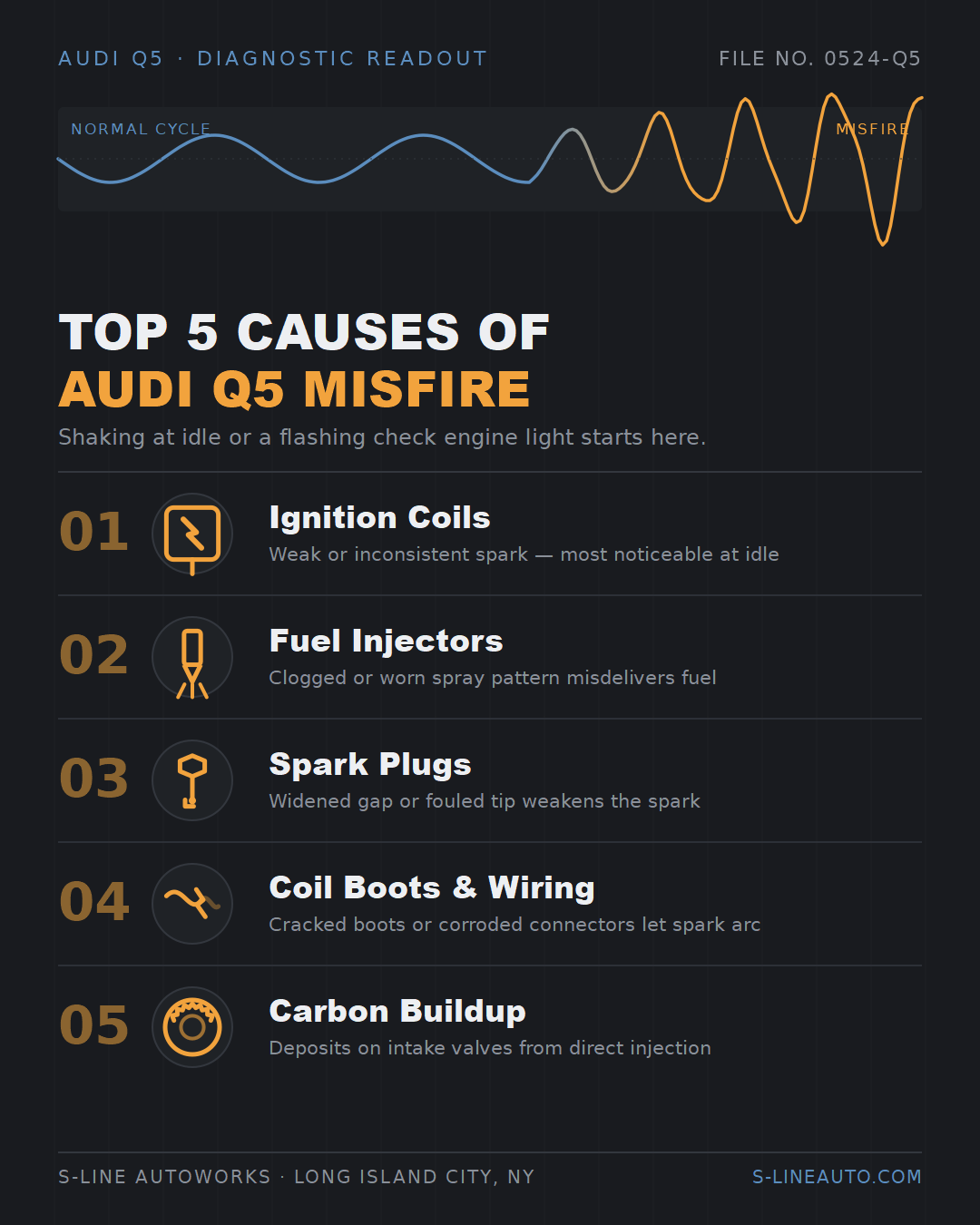
Every one of these can cause the exact same shaking, stumbling, and check-engine-light symptoms. That overlap is exactly why guessing which part to replace is such an expensive gamble.
1. Bad Ignition Coils
Your Audi Q5 uses what’s called a “coil-on-plug” ignition system. Instead of one central coil and a distributor like older cars, each cylinder gets its own small ignition coil sitting directly on top of its spark plug. That coil’s job is to take the 12 volts from your battery and multiply it into the thousands of volts needed to fire the plug, dozens of times per second.
Because ignition coils sit right on top of a hot engine and deal with constant vibration, they’re a wear item. When one starts to weaken, that cylinder gets a weak or inconsistent spark instead of a strong one. You’ll usually feel it most at idle, since there’s no extra engine speed or load to help mask a cylinder that isn’t pulling its full weight.
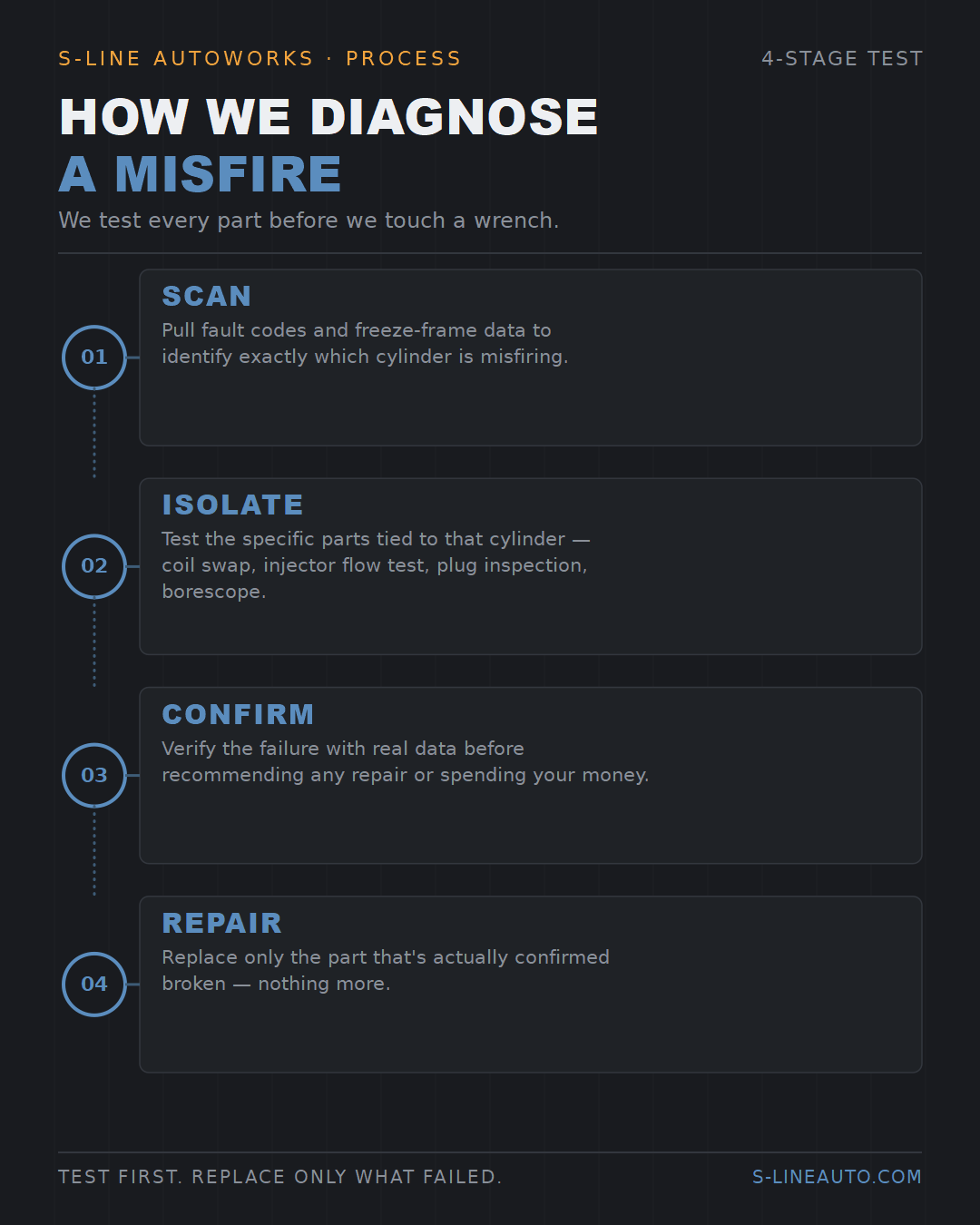
How we diagnose it: We start by pulling the fault codes, which usually point to a specific cylinder. From there, we run a coil swap test — moving the coil from a healthy cylinder to the suspect one. If the misfire follows the coil to its new cylinder, we’ve confirmed the coil (not the plug or the wiring) is the problem, and we replace only that one part.
2. Faulty Fuel Injectors
The Q5’s engine uses direct injection, meaning fuel is sprayed at very high pressure straight into each cylinder rather than into the intake port. It’s a precise system, and each injector has to deliver the exact right amount of fuel, in the exact right pattern, at the exact right moment.
Over time, injectors can get partially clogged with fuel deposits, develop a weak or lazy spray pattern, or, less often, fail electrically. Whatever the cause, that cylinder ends up running lean, rich, or not firing cleanly — producing the same rough idle and misfire feeling as a bad coil or spark plug.
How we diagnose it: Because a weak injector feels almost identical to a bad coil or plug, we test it rather than assume. That means checking each injector’s electrical response and, when needed, pulling it for a bench flow test to see its actual spray pattern. It’s also why, whenever we’re already inside the intake for a carbon cleaning (more on that below), we test every injector while we’re in there — it’s the easiest time to catch a weak one before it becomes its own separate repair down the road.
3. Worn Spark Plugs
Spark plugs are the most familiar part on this list — the small parts that actually create the spark that ignites the air-fuel mixture in each cylinder. It’s also the part most people assume is the problem the moment their car starts shaking, and sometimes they’re right.
As plugs age, the gap between the electrodes widens, deposits build up on the tip, and the spark gets weaker and less consistent. That produces the same kind of misfire and rough idle as a failing coil, often most noticeable on a cold start or at a stoplight.
How we diagnose it: We pull a plug and actually look at it. The gap, the color, and the condition of the electrode tell an experienced tech a lot about what’s really happening in that cylinder — including clues about oil or fuel issues that a fresh set of plugs alone won’t fix. If the plugs are simply worn out, that’s an easy, affordable repair. If they look fine, we know to keep looking rather than replacing parts that were never the problem.
4. Damaged Coil Boots & Ignition Wiring
Older cars used a single set of spark plug wires running from a distributor to each cylinder, and that’s still the first thing a lot of drivers — and some less experienced shops — reach for on any misfire. Modern Audis don’t use that setup. As mentioned above, each cylinder has its own coil sitting directly on the plug. But every one of those coils still has a rubber boot sealing it against the spark plug well, plus a wiring harness and connector feeding it power and timing signals from the engine computer.
After enough heat cycles, a boot can crack or let moisture in, letting the spark arc and leak instead of firing the plug the way it should. Connectors can also corrode or work loose. Either problem produces the same misfire and shake as a bad coil, because electrically, that’s effectively what’s happening.
How we diagnose it: We visually inspect the boots for cracking or the telltale carbon “tracking” marks that show a spark has been arcing where it shouldn’t, and we check the wiring harness and connectors for corrosion or resistance issues. It’s a simple check, but an easy one for a shop to skip if they’re not familiar with how Audi’s ignition system is actually built.
5. Carbon Buildup From Direct Injection
This last cause is the one most owners have never heard of, and it’s one of the most common misfire triggers we see on Audi and Volkswagen engines specifically. Direct injection — the same system responsible for cause #2 on this list — sprays fuel straight into the cylinder instead of the intake port. That’s great for power and fuel economy, but it means fuel never washes over the back of the intake valves the way it does in older engines. Instead, oil vapor from the engine’s own crankcase ventilation system settles there and slowly hardens into carbon deposits.
Over tens of thousands of miles, that buildup restricts airflow into the cylinder and can interfere with how well the intake valve seals — showing up as rough idle, hesitation, misfires (especially right after a cold start), and check engine lights that can be hard to pin down with a basic code reader.
How we diagnose it: We don’t recommend a carbon cleaning as a guess. We inspect the intake valves with a borescope, a small camera that lets us actually see the buildup, before recommending the service — so you know it’s needed rather than just possible. When it is needed, we clean it using walnut shell media blasting, which is soft enough not to damage the valves but hard enough to remove the deposits, restoring airflow and smoothing out the idle.
Why Proper Diagnosis Matters
Here’s the challenge: every single cause on this list can produce the exact same symptoms — shaking at idle, a rough stumble at a red light, and a check engine light that’s flashing or steady. You genuinely cannot tell them apart just by how the car feels. That takes real diagnostic testing.
This is exactly where a lot of Audi and VW owners get burned. A shop that isn’t set up for European diagnostics, or one that doesn’t want to spend the time testing, will often start swapping parts and hoping one of them fixes it: new coils, then new plugs, then an injector. Sometimes it happens to work. More often, the owner pays for parts that were never the problem, and the misfire is still there.
A shop that specializes in European vehicles has the tools to actually test each component individually — scan tools with live Audi-specific data, coil and injector testers, fuel pressure gauges, and a borescope — and narrow the problem down to the one part that actually failed. That’s the difference between a repair bill for one part and a repair bill for five.
Frequently Asked Questions From Our Customers
Is it safe to drive with a flashing check engine light?
No. A flashing check engine light means an active, severe misfire, and unburned fuel is being dumped into your exhaust system, where it can quickly overheat and damage your catalytic converter. If your light is flashing rather than just steady, it’s best to stop driving and have it looked at as soon as possible.
How much does it cost to fix a misfire on an Audi Q5?
It depends entirely on which of the causes above is actually responsible. A single spark plug or coil is a very different repair than a fuel injector or a full carbon cleaning. This is exactly why we diagnose and test before quoting a repair, so you’re paying for the part that’s actually broken instead of a guess.
Can I just replace the coils and spark plugs myself and see if that fixes it?
You can, and sometimes that is the fix. But if the real cause is a fuel injector, wiring, or carbon buildup, you’ll have spent time and money without solving the problem, and a misfire left unaddressed can end up damaging your catalytic converter. If a DIY coil-and-plug swap doesn’t fully resolve the shaking, that’s a good sign it’s time for a proper diagnostic scan.
How do I know if it’s the coils, injectors, spark plugs, or something else?
Honestly, you can’t tell from the driver’s seat — all of these causes feel similar. That’s what diagnostic testing is for. Our technicians pull the fault codes, then test the specific components tied to those codes, including coil swaps, injector testing, and a borescope look at the intake valves, until we’ve confirmed the actual cause.
Get Your Audi Q5 Properly Diagnosed in Long Island City
If your Audi Q5 is shaking at idle or throwing a flashing check engine light, the fastest way to actually fix it, and the cheapest way in the long run, is to have it professionally diagnosed rather than guessed at. A shop that knows Audi and Volkswagen vehicles inside and out can test each component individually and tell you exactly which one failed, instead of replacing random parts in the ignition system and hoping something sticks.
That’s exactly what we do. You’re always welcome to reach out to S-Line Auto, your European car repair experts in Long Island City, Queens — visit us at s-lineauto.com or stop by the shop, and we’ll get your Q5 or other European brand models running smoothly again.

