
A BMW coolant leak on the driver’s side of the engine is a pattern we see again and again on newer BMWs. At S-line Autoworks in Long Island City, Queens, it shows up most often on 2017–2019 models with 80,000 to 100,000 miles on the odometer: a 330i, 340i, 430i, 440i, 530i or X1 starts losing coolant, and the leak usually comes from one of three places.
Below, we explain those three places in plain English, how we track the leak down with a pressure test, and why it pays to fix it before it turns into engine damage.
What Causes a BMW Coolant Leak on the Driver’s Side?
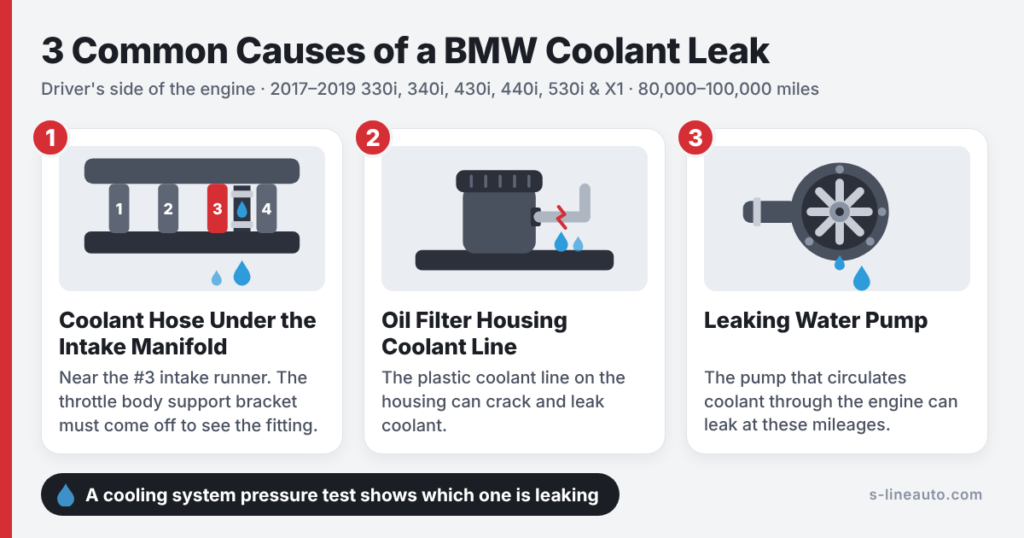
On the 2017–2019 models we see, a BMW coolant leak on the driver’s side of the engine usually comes from one of three parts. Here they are, in the order we typically find them:
- A coolant hose under the intake manifold, where it connects to the cylinder head.
- A cracked plastic coolant line on the oil filter housing.
- A leaking water pump.
A cooling system pressure test shows which one is leaking, so nothing gets replaced on a guess.
Which BMW Models Are Affected?
We see this driver’s-side coolant leak most often on the models below, usually between 80,000 and 100,000 miles:
| Model year | Model | Engine |
|---|---|---|
| 2017 | BMW 330i | 2.0L turbo 4-cylinder (B48) |
| 2018 | BMW 340i | 3.0L turbo 6-cylinder (B58) |
| 2019 | BMW 430i | 2.0L turbo 4-cylinder (B48) |
| 2017 | BMW 430i Gran Coupe | 2.0L turbo 4-cylinder (B48) |
| 2017 | BMW 430i xDrive | 2.0L turbo 4-cylinder (B48) |
| 2017 | BMW 440i | 3.0L turbo 6-cylinder (B58) |
| 2017 | BMW 530i | 2.0L turbo 4-cylinder (B48) |
| 2018 | BMW X1 | 2.0L turbo 4-cylinder (B46) |
Other BMWs with these same engines can develop similar leaks. If yours isn’t listed but is losing coolant, it’s worth having checked.
BMW Coolant Leak Symptoms: What to Watch For
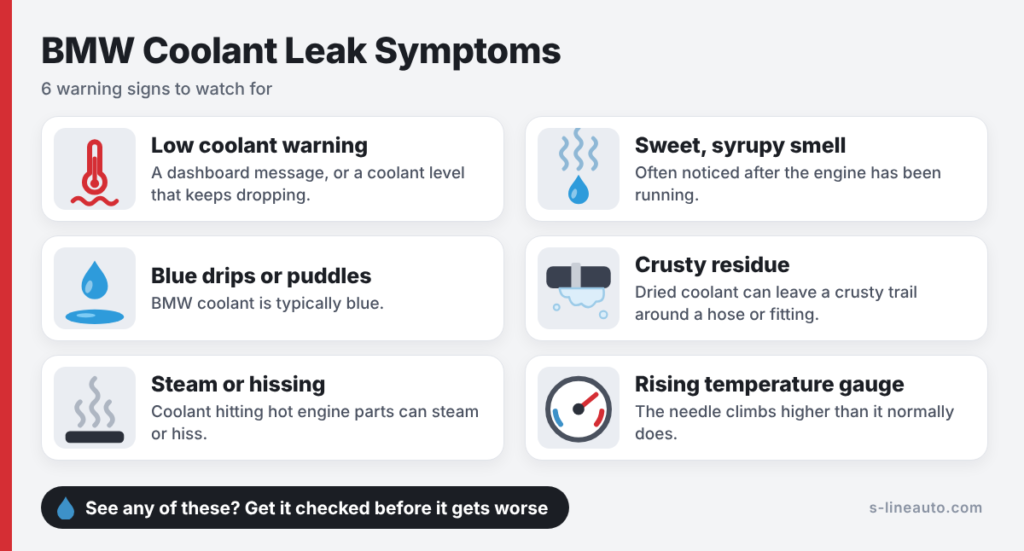
Some BMW coolant leaks leave a puddle. Others stay hidden, because coolant can burn off hot engine parts before it ever reaches the ground. Here is what to watch for:
- A low coolant warning on the dash, or a coolant level that keeps dropping after you top it off.
- A sweet, syrupy smell from the engine bay or through the vents.
- Drips or a puddle under the front of the car. BMW coolant is typically bright blue.
- Dried, crusty residue around hoses and fittings under the hood.
- Steam or hissing from the engine bay after a drive.
- A temperature gauge that climbs higher than normal.
If you notice any of these, don’t wait for a puddle to confirm it.
The 3 Most Common Causes of a BMW Coolant Leak on the Driver’s Side
By 80,000 to 100,000 miles, heat and age take a toll on the rubber and plastic parts that carry coolant. When we pressure test these BMWs, the leak traces back to the same three places, in this order.
1. A Leaking Coolant Hose Under the Intake Manifold
The intake manifold is the part on top of the engine that feeds air to the cylinders. Tucked underneath it, near the number 3 intake runner, a coolant hose connects to the cylinder head, the section of the engine where coolant carries heat away.
This one is easy to miss because it is buried. To even see the hose fitting at the cylinder head, our technicians have to remove the throttle body support bracket first. Coolant that escapes here can run down into hard-to-see areas or evaporate off hot parts, so you may never see a clear puddle. What you notice instead is a coolant level that slowly drops, a low coolant warning, or a faint sweet smell after a drive.
2. A Cracked Plastic Coolant Line on the Oil Filter Housing
A BMW oil filter housing leak is a well-known weak spot on these engines. The housing holds your oil filter, and a plastic coolant line is attached to it. Plastic that spends years beside a hot engine gets brittle, and on these BMWs we regularly find that coolant line cracked. A crack lets coolant seep out, and the coolant level creeps down.
3. A Leaking Water Pump
A BMW water pump leak is another common source of coolant loss on these cars. The water pump keeps coolant moving through the engine, a bit like a heart moving blood. As a pump ages, its seals wear and coolant begins to seep out. A leaking pump is also a warning sign: if it fails completely, coolant stops circulating and the engine can overheat fast.
All three leaks can look the same from the outside: low coolant and a faint sweet smell. Telling them apart takes testing, which is exactly how we find the source.
How We Find a BMW Coolant Leak: The Cooling System Pressure Test
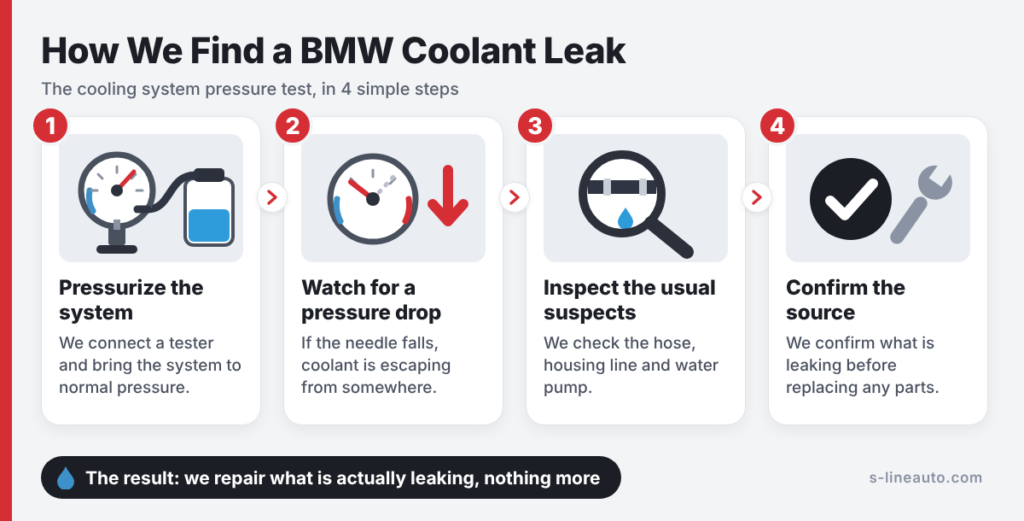
Guessing is the most expensive way to fix a BMW coolant leak. Instead of replacing parts and hoping, we use a cooling system pressure test:
- We pressurize the cooling system. A special tester builds pressure in the system, similar to what it sees when the engine is hot.
- We watch for a pressure drop. If the pressure falls, coolant is escaping somewhere. The pressure also pushes coolant out of weak spots, so a leak that only appears when the engine is hot shows itself in the shop.
- We inspect the usual suspects. On these BMWs, that means the hose under the intake manifold, the plastic coolant line on the oil filter housing, and the water pump.
- We confirm the source before we repair anything, so the fix targets the part that is actually leaking.
This is where BMW experience pays off. A hose buried under the intake manifold will never show up in a quick look under the hood. Knowing where to look, and what has to come off to reach it, saves time and keeps you from paying for parts you didn’t need.
Why You Shouldn’t Ignore a BMW Coolant Leak
Coolant keeps your engine at the right temperature. When the level drops, the engine can overheat, and an overheated engine can end up with a warped cylinder head or a blown head gasket. Those repairs cost far more than fixing the original leak.
A few more reasons not to wait:
- Small leaks turn into big ones. A cracked line or a worn seal can let go with little warning.
- Breakdowns are common. The Car Care Council, a non-profit, lists cooling system trouble among the leading causes of breakdowns.
- Safety. An overheating car can strand you in traffic, and leaked coolant is toxic to pets and children, so puddles need to be cleaned up.
What to Do If You Think Your BMW Is Leaking Coolant
- Watch the temperature gauge. If it climbs or a warning appears, pull over when it’s safe and shut the engine off.
- Never open the coolant cap on a hot engine. The system is under pressure, and hot coolant can spray out and burn you.
- Check the coolant level only when the engine is cold. If it’s low and the engine isn’t overheating, a top-off with the correct BMW-approved coolant can get you to the shop. That is a short-term fix, not a repair.
- Skip the stop-leak additives. At best they are a temporary patch, and they can clog small passages in the cooling system.
- Have it pressure tested. It is the most reliable way to find out where the coolant is going.
What to Expect From a BMW Coolant Leak Repair
The time and cost depend on which part is leaking and how much has to come off to reach it. A leaking water pump is one kind of job. A hose buried under the intake manifold is another, because parts like the throttle body support bracket have to come off before the hose can even be seen.
Here is how it works at our shop:
- We pressure test the cooling system to find the source of the leak.
- We explain what we found and what the repair involves, and give you an estimate.
- We repair the leak, and our work is backed by a warranty of 1 year or 12,000 miles, whichever comes first.
Driving a different BMW? Our guide to common BMW X3 problems covers other cooling system leaks we see, such as radiators and expansion tanks.
Why Drivers Choose a European Car Repair Specialist for BMW Cooling Problems
Fixing a coolant leak on a modern BMW is rarely as simple as swapping one part. The engine bay is tightly packed, many cooling parts are made of plastic that gets brittle with heat and age, and reaching the leak often means removing other parts first, carefully, so nothing else gets damaged.
That is where a European car repair specialist makes a difference:
- We know the pattern. We see these same leaks on these same engines often enough to know where to look first.
- We have the right equipment. A cooling system pressure test finds the leak, so there is no guessing and no replacing parts that were fine.
- We have the experience. Our mechanics have been in auto repair for over 20 years, with a focus on German and other European cars.
- We keep it fair. Our goal is dealer-level service at affordable prices.
Curious what else we work on? Browse our full list of auto repair services.
BMW Coolant Leak FAQ
Which BMW models get a coolant leak on the driver’s side?
We most often see it on 2017–2019 BMWs with the 2.0L or 3.0L turbo engines: the 330i, 340i, 430i (including the Gran Coupe and xDrive), 440i, 530i and X1. It tends to show up between 80,000 and 100,000 miles.
Can I drive my BMW with a coolant leak?
It is not a good idea. A small leak can get worse quickly, and an engine that runs low on coolant can overheat, which can cause serious damage. If the temperature gauge climbs or a warning appears, pull over safely, turn the engine off and have the car checked as soon as possible.
Why am I losing coolant but don’t see a puddle?
Leaks on these engines are often small and hidden. Coolant can drip onto hot engine parts and evaporate before it ever reaches the ground, or leak in a spot you can’t see from underneath the car. In some cases coolant can also be lost inside the engine, which is another reason a proper diagnosis matters. A pressure test is the most reliable way to find the source.
What does a BMW coolant leak smell like?
Usually a sweet, syrupy smell, most noticeable after the engine has been running or right after you park. BMW coolant is typically blue, so blue drips or dried crusty residue under the hood are another clue.
How much does it cost to fix a BMW coolant leak?
It depends on which part is leaking and how much has to come off to reach it. A pressure test tells us exactly what is needed, and we explain the repair and give you an estimate before any work begins.
Is it normal for my BMW to need coolant top-offs?
No. A healthy, sealed cooling system should not lose coolant between services. If you keep adding coolant, something is leaking, and it is best to find it before it turns into a bigger repair.
Get Your BMW Coolant Leak Professionally Diagnosed and Repaired
A coolant leak will not fix itself, and the longer it goes, the more risk to your engine. A hose under the intake manifold, a cracked plastic coolant line on the oil filter housing and a leaking water pump are the three culprits we find most often on these BMWs, but the only way to know which one is yours is to test for it.
That is why it is best to have your coolant leak professionally diagnosed and addressed. If your BMW is losing coolant, you are always welcome to contact S-line Autoworks in Long Island City, Queens. Call us at (718) 361-1937 or reach out online and we will take a look.

